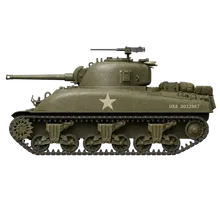
Gunnery and armour
Handbook · chapter 5
A Sherman's 75 mm gun and its armour are what your platoon fights with and hides behind, and in 1943 both are adequate against most of what you meet and hopeless against the rest. This chapter follows a shot from the fire command to the shell landing, and then the other way: what happens inside a tank when a shell comes through the plate.
Moving
A tank has three speeds: cautious, normal and fast. On a road it is noticeably quicker than across country at each, and the ground it crosses slows it by the cover it is in. A fast tank across country covers a couple of hundred metres in a period; a cautious one well under a hundred.
The driver plans his own path, weighing distance, the going and the risk of bogging, and a poor driver sometimes treats a bog cell as ordinary ground. In a bog-risk cell, or at fast speed anywhere, there is a small chance every second of trouble, which adds up over a period: fast is worse, a sharp turn taken fast is a risk of its own, and a skilled driver halves the chance while a green one runs half again the risk. Half the trouble is a bogged tank, which the driver rocks free in a few minutes. Half is a thrown track: the better part of half an hour with four men outside, who are infantry in the open for as long as it takes and, under fire, may not work at all.
The turret comes round at a fixed rate. A jammed turret does not come round at all.
The fire sequence
Between the commander seeing a target and the gun firing there is a sequence, and every step takes time. The commander gives the fire command: a few seconds, longer for an unskilled man, twice as long if he is buttoned up. The gunner lays: several seconds, quicker with skill and slower with stress, and half as long if he is already ranged in on the same target. The loader cycles a round from the ready rack: a few seconds, likewise, and twice as long once the rack is empty and he is drawing from stowage. And the turret has to come round, if it is not already pointing the right way.
An M4A1 carries 90 rounds of 75 mm, of which 12 are in the ready rack in the turret. The default load is 40 armour-piercing, 44 high explosive and 6 white phosphorus. The loader restocks the rack only while the gun is idle, and a competent loader does so without being asked.
Hitting
A stationary Sherman with an average gunner on a clear day will hit a stationary, tank-sized target almost every time inside a few hundred metres, about even odds at a kilometre, one time in four at fifteen hundred, and rarely beyond.
Everything else multiplies that. Being ranged in helps a great deal. A moving target is harder; a moving firer rarely hits anything. A hull-down target is harder, an anti-tank gun much harder still. Haze, dust or rain on the line cut the chance, dusk cuts it further, and a rushed shot from a rattled gunner cuts it in half. A good gunner adds to all of it; a shaken one takes from it. High explosive at infantry is more forgiving, because a near miss still counts.
A miss lands short or over along the line of fire, and it is a shell impact for whoever is near it. High explosive fired at a place rather than a thing lands with the error of the contact it was aimed by, plus a little scatter. White phosphorus makes a cloud that blocks sight for a minute or two and drifts with the wind.
Hit and penetration
A hit lands somewhere on the target, and where depends on the facing. From the front, most hits land on the hull front, then the turret and mantlet, then the tracks; a few find the gun and a few do nothing. From the side or rear, most land on the hull.
The plate the shell meets has a thickness and a slope, and the slope compounds with the angle of the shot, so a shell that arrives obliquely meets far more steel than the plate’s nominal thickness; a shot at a very steep angle glances off without a roll. Otherwise the shell’s penetration at that range, from the tables in the order of battle, is set against the effective armour, and the chance to go through rises smoothly with the margin: even odds when they are equal, near certain when the shell has a comfortable margin over the plate, near nothing when the plate has the margin. A failed penetration is a ricochet, or a shatter on a near thing.
Inside the tank
A penetration rolls, row by row, on what it might have done where it came in. A turret penetration risks the commander, the gunner and the loader, the gun and the traverse, and, in a dry-stowage tank, very likely the ammunition. A hull-front penetration risks the driver and bow gunner, the transmission, and the ammunition again. A hull-side penetration risks a man in each compartment, the ammunition likelier still, and the fuel. A hull-rear penetration usually stops the engine. A hit on the tracks usually immobilises the tank and a hit on the gun usually disables it.
A casualty is more often wounded than killed. A wounded man stays in his seat, working at half his skill and badly shaken, until the crew bails and carries him out. A tank with an ammunition fire or a fuel fire is knocked out and brews up within seconds, and any man still inside when it does is killed. A tank with two seats empty, or with its gun disabled and its tracks gone, is knocked out even if it is not burning. Bailing out takes a few seconds per man, longer for a wounded one, and a bailed crew is an unarmed, fully suppressed infantry team.
Infantry
Infantry and gun crews are not killed by fire so much as stopped by it. Every shell landing near them, every burst on them, every tank closing on them adds suppression; every casualty adds more; and it drains away slowly when the fire stops. A team that is pinned does not move and fires slowly. A team that is broken does not fire and, each period, may run; a gun crew is harder to shift than a rifle squad. Strength comes off a team with HE landing close and with sustained machine-gun fire, less whatever cover it is in, and a team down to its last few men is finished.
A team that is not pinned and finds a tank halted and buttoned up beside it, or one that cannot move, will assault. Each period it may succeed, more likely if the bow gunner is dead or frozen: an assault immobilises a halted, buttoned tank and knocks out one that already cannot move. A working bow gunner, or a commander firing from an open hatch, suppresses the team first.
In the Reference: §5.1, §5.2, §5.3, §5.4, §5.5, §6.1, §6.5, §6.2, §6.3, §6.4, §6.6, §6.7, §7.1, §7.2, §7.3, §7.4, §7.5, §7.6, §7.7, §7.8