Seeing and hearing
Handbook · chapter 4
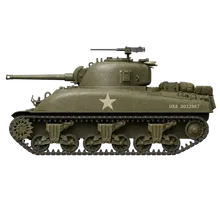
A Sherman is a poor place to see from. Five men, each with his own slit of the world, on ground that hides things, in weather that hides more, trying to tell a Panzer IV from a Tiger at a kilometre while being shot at. This chapter is about what they see, what they get wrong, and how it becomes the marks on your map.
The ground
The sheet is real ground. A battle’s map is baked from elevation data and mapped features of the place it is set. The map is a grid of small cells, each with a height and one kind of cover.
Cover does three things. It slows a tank: a road is quick, open ground is the baseline, scrub and cultivated land cost a little, a grove or a village or a wadi bed a great deal, marsh most of all. It hides whatever is in it: open ground hides nothing, a grove or a village hides a unit well. And some of it stands up: a grove or a village is high enough to block a line of sight through it. A wadi bed and marsh can bog a tank. Buildings sit on top: stone hides infantry better than mud-brick, HE knocks them down, and a building that comes down comes down on the men inside it.
Hull-down is never something you declare. For a tank and a bearing, the ground in front is sampled along that bearing, and if it hides the hull but not the turret, the tank is hull-down against that bearing. The same test, from the enemy’s side, decides whether he can hit the hull at all.
Who sees what
Each seat sees through its own device, and which device depends on whether the hatch is open. The commander, head out with binoculars, sees all round and sees best; buttoned up, he has a periscope covering a narrow arc forward of the turret and sees far less. The gunner sees only through his telescope, a narrow arc where the gun is pointing. The loader sees nothing. The driver and the bow gunner see forward, a wide arc but not well, and worse when buttoned up.
Spotting
Every second, every seat that can see rolls to spot each enemy in its line of sight and inside its arc. The chance depends on what the thing is: a tank is easiest, a soft vehicle or an infantry team harder, a dug-in anti-tank gun hardest of all. It falls away fast with range. It is cut by the cover the target is in, and cut again if he is hull-down. It depends on the device, and on the man: an aware man sees more, a shaken one less.
A moving target is easier to see, and one raising dust easier still. A target that has just fired is much easier for the few seconds after its shot, because a muzzle flash is a thing to see whatever the gun is hiding behind: a dug-in gun in scrub at long range is seen on about half the shots it fires, and seldom while it stays silent. Haze, rain and dusk cut every chance; smoke on the line blocks sight entirely.
A contact stays fresh every second some seat has it in view. When nobody does, the contact keeps its last position on the plot and loses confidence, period by period, until it is stale.
Seeing is not knowing
When a seat gains a contact, the man guesses what it is and where it is, and both guesses can be wrong. He may misidentify it, more often at long range and more often if he is green, and the wrong answer is always something of the same class that he has heard of. Green crews call any big tank a Tiger. He places it some way off its true position, in a random direction, farther out at long range and farther if he is unskilled, and his range estimate is out by the same amount.
The first look is fixed. A long look is not: every few seconds of continuous observation halve the position error and give him another chance at the identification, so a crew that watches a thing converges on the truth.
Hearing and feeling
Some things are known without being seen, by every man in the tank: a shell landing close, a hit on their own tank, a penetration more so. Gunfire within earshot gives the crew a rough bearing; it is a spotting cue, not a shock. A tank brewing up is a shock to everyone who can see it.
A burning hull stays a thing to see for the rest of the battle. Its column of smoke is sighted with certainty by any tank that comes to have a line to it, so a kill that burned out of everyone’s sight is marked the moment someone sees the smoke. To whoever has seen it burn it is a wreck and not a threat, and an engage order on it is refused. A hull that is knocked out but does not burn is seen only while its crew climb out; once they are gone it is a dead hull that nobody marks.
The plot
The map shows a contact where tank one believes it is, inside a circle of the error you can expect, not the error the dice rolled: wider at long range, halved for something watched a while, doubled for something that came over the net. Overlapping circles on a coarse view draw as one with a count, and tanks of the platoon close together draw as one platoon sign.
A contact is greyed when nobody has confirmed it: your own crew’s the moment they lose sight of it, a reported one when no fresh report has come for a couple of periods. A contact your crew saw knocked out, or first saw afterwards with its crew bailing out, is struck through; one they saw brew up burns on the plot for the rest of the battle. A kill nobody saw is never marked: a gun that falls silent out of sight stays a gun on the plot.
Point at a sign and you are told what the plot holds of it and no more. Each tank’s card carries its crew as five bars in seat order, coloured by wounds and stress, hatched while a man is outside the tank, with the commander’s seat shown in reverse while his hatch is closed, so you can see where his eyes are.
The record and the enemy
Every event carries its tick and the things involved. There are two logs, the truth and what tank one perceived, and the second is all you see until the battle is over.
The enemy is scripted, not played. A group holds, advances along its axis, withdraws to its rally point, or assaults, and a trigger moves it from one behaviour to the next: a period reached, losses taken. Between triggers an advancing vehicle halts to engage when it sees a contact close enough, stays halted a while, and comes on.
In the Reference: §3.1, §3.2, §3.5, §3.3, §3.4, §4.1, §4.2, §4.3, §4.4, §4.5, §4.6, §4.7, §12.1, §12.2